Showing posts with label blended. Show all posts

Wednesday, May 26, 2010

Methods for Blended Learning

Margaret Driscoll of IBM write a great article on examples of various methods for blended learning:


Here's the list, see the article for details:


1. Put the assessment online.


2. Follow up with a community of practice.


3. Make reference materials available.


4. Deliver pre-work online.


5. Provide online office hours.


6. Use mentoring/coaching as a tool.


7. Provide job-aids.


8. Access experts.


9. Create a "lifeline".


10. Maximize e-mail and messaging.


I always say that if you teach online the same way you teach face-to-face, then you're not really teaching online. How does your style change when you tech online.


Thursday, May 20, 2010

Engagement in Technology

According to a Thompson Netg job security study in 2002, blended learning yielded better results than online learning alone.


They point out:


  1. Blended Learning performance was 30% more accurate than e-learning alone


  2. Blended learning performance on the real world task was 41 percent faster than e-learning alone


  3. Blended learning performance was 159% more accurate than no training


  4. E-learning was 99% more accurate than no training


The results of the study say scenario-based exercises are the most effective for face to face and online materials.


For more on Blended Learning, check out the Brandon Hall Report: The Real Story: Blended Learning.


Thursday, May 13, 2010

Personalized Learning

According to a Brandon Hall report on Blended Learning:


"Design and development of blended learning requires a holistic approach involving modern pedagogy, learner needs and expectations, and technology.... A key design aspect of blended learning should be aimed at personalized learning with a human or virtual guide to direct and support the individual learner."


Citing research by Sharpe ("Success Factors for Blended Learning"), the following design factors were highlighted:


  1. Analysis of successful and successful features of the course content (including learner feedback)


  2. Undertaking the design as a team, ensuring staff members have the time to properly integrate face to face and online material


  3. Designs that make explicit their underlying principles -- these could be established pedagogical principles, active learning, repetition and elaboration, prompt and frequent feedback, or course outcomes


  4. Developing the course iteratively over a number of years


  5. Help students develop conceptions of the learning process


  6. Disseminate and communicate the results of evaluations.


So how does your blended course stack up? Comments please:)


Tuesday, May 11, 2010

CTL Blended Learning Blog

The CTL has attempted to use blogs to convey information about fellowships and to publicize activities . . . the blended learning blog was created to share information about blended learning. It was the first WordPress blog for us, we use Blogger mostly, but it turned out well.


View the blog here


Screen shot 2010-04-21 at 3.20.40 AM.png


Wednesday, February 24, 2010

Teacher vs Learner Centered Learning

I'm typically the person in the room who uses words that end with '-centric', ego-centric & exo-centric are personal faves as well as user-centric. In the blended learning fellowship, I am often caught talking about learner-centric activities.


I often think that most educators 'teach they way they were taught'. When transitioning to an online setting, this is academic suicide. We must take the view of the learner when creating lectures, designing activities, and developing assessments.


Some of the literature uses the word "connectedness" to describe the paradigm shift away from teacher-centered instruction.
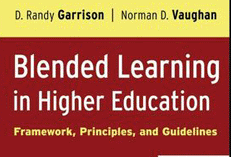

Screen shot 2010-04-23 at 12.38.57 PM.png One of the reason we chose the book "Blended Learning in Higher Education" was to highlight the need for community and connectivity in an online environment.


More than a technology book, it delves into issues of pedagogy in the online classroom and provides a 3 point framework to follow called the "Community of Inquiry". [view PPT]


While not covered in the book, the term 'blended learning' does not embody the 'learner-centric' paradigm...it's teacher-centric:) I won't argue against it, but food for thought.


Taken from the publisher's website, the book has the following main areas:


  • Outlines seven blended learning redesign principles


  • Explains the professional development issues essential to the implementation of blended learning designs


  • Presents six illustrative scenarios of blended learning design


  • Contains practical guidelines to blended learning redesign


  • Describes techniques and tools for engaging students

From all accounts, fellows did find the book helpful. Moreover, they agreed that building a course in a blended manner was a great way to redesign their course; allowing for new ideas to be implemented into an existing curriculum.

Here;a another nice article on the paradigm shift from instructional vs. learning paradigm.